According to the survey findings, most Muslims believe sharia is the revealed word of God rather than a body of law developed by men based on the word of God. Muslims also tend to believe sharia has only one, true understanding, but this opinion is far from universal; in some countries, substantial minorities of Muslims believe sharia should be open to multiple interpretations. Religious commitment is closely linked to views about sharia: Muslims who pray several times a day are more likely to say sharia is the revealed word of God, to say that it has only one interpretation and to support the implementation of Islamic law in their country.
Although many Muslims around the world say sharia should be the law of the land in their country, the survey reveals divergent opinions about the precise application of Islamic law.14 Generally, supporters of sharia are most comfortable with its application in cases of family or property disputes. In most regions, fewer favor other specific aspects of sharia, such as cutting off the hands of thieves and executing people who convert from Islam to another faith.
Sharia as Divine Revelation
gsi2-chp1-1
In 17 of the 23 countries where the question was asked, at least half of Muslims say sharia is the revealed word of God. (For more information on sharia see text box.) In no country are Muslims significantly more likely to say sharia was developed by men than to say it is the revealed word of God.
Acceptance of sharia as the revealed word of God is high across South Asia and most of the Middle East and North Africa. For example, roughly eight-in-ten Muslims (81%) in Pakistan and Jordan say sharia is the revealed word of God, as do clear majorities in most other countries surveyed in these two regions. Only in Lebanon is opinion more closely divided: 49% of Muslims say sharia is the divine word of God, while 38% say men have developed sharia from God’s word.
Muslims in Southeast Asia and Central Asia are somewhat less likely to say sharia comes directly from God. Only in Kyrgyzstan (69%) do more than two-thirds say Islamic law is the revealed word of God. Elsewhere in these regions, the percentage of Muslims who say it is the revealed word of God ranges from roughly four-in-ten in Malaysia (41%) to six-in-ten in Tajikistan.
Views about the origins of sharia are more mixed in Southern and Eastern Europe. At least half of Muslims describe sharia as the divine word of God in Russia (56%) and Bosnia-Herzegovina (52%). By contrast, three-in-ten or fewer hold this view in Kosovo (30%) and Albania (24%).
Overall, Muslims who pray several times a day are more likely to believe that sharia is the revealed word of God than are those who pray less frequently. This is the case in many countries where the question was asked, with especially large differences observed in Russia (+33 percentage points), Uzbekistan (+21), Kyrgyzstan (+20) and Egypt (+15). Views on the origins of sharia do not vary consistently with other measures, such as age or gender.
Interpreting Sharia
gsi2-chp1-2
Muslims differ widely as to whether sharia should be open to multiple understandings. While many say there is only one true interpretation, substantial percentages in most countries either say there are multiple interpretations or say they do not know.
A majority of Muslims in three Central Asian countries – Tajikistan (70%), Azerbaijan (65%) and Kyrgyzstan (55%) – say there is only one way to understand sharia. But elsewhere in the region there is less consensus, including in Turkey, where identical proportions (36% each) stand on either side of the question.
Muslims in Southern and Eastern Europe tend to lean in favor of a single interpretation of sharia. However, only in Bosnia-Herzegovina (56%) and Russia (56%), do majorities take this position.
Across the countries surveyed in South Asia, majorities consistently say there is only one possible way to understand sharia. The proportion holding this view ranges from 67% in Afghanistan to 57% in Bangladesh. But more than a quarter of Muslims in Afghanistan (29%) and Bangladesh (38%) say sharia should be open to multiple interpretations.
In the Middle East-North Africa region, belief in a single interpretation of sharia prevails in Lebanon (59%) and the Palestinian territories (51%). But opinion in Iraq is mixed: 46% say there is only one possible way to understand sharia, while 48% disagree. And in Tunisia and Morocco, large majorities (72% and 60%, respectively) believe sharia should be open to multiple interpretations.
In Southeast Asia, opinion leans modestly in favor of a single interpretation of sharia. The biggest divide is found in Thailand, where 51% of Muslims say there is only one possible understanding of Islamic law, while 29% say it should be open to multiple interpretations.
In a number of countries, significant percentages say they are unsure whether sharia should be subject to one or multiple understandings, including at least one-in-five Muslims in Albania (46%), Kosovo (42%), Uzbekistan (35%), Turkey (23%), Russia (21%), Malaysia (20%) and Pakistan (20%).
An individual’s degree of religious commitment appears to influence views on interpreting sharia. In many countries where the question was asked, Muslims who pray several times a day are more likely than those who pray less often to say that there is a single interpretation. The largest differences are found in Russia (+33 percentage points) and Uzbekistan (+27), but substantial gaps are also observed in Lebanon (+18), Malaysia (+16) and Thailand (+15).
Sharia as the Official Law of the Land
gsi2-chp1-3
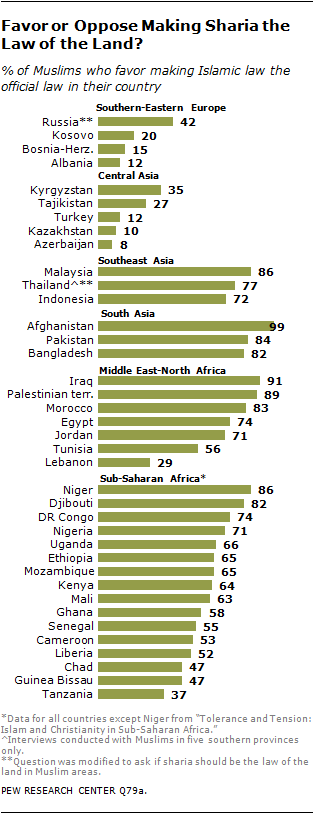
Support for making sharia the official law of the land varies significantly across the six major regions included in the study. In countries across South Asia, Southeast Asia, sub-Saharan Africa and the Middle East-North Africa region most favor making sharia their country’s official legal code. By contrast, only a minority of Muslims across Central Asia as well as Southern and Eastern Europe want sharia to be the official law of the land.
In South Asia, high percentages in all the countries surveyed support making sharia the official law, including nearly universal support among Muslims in Afghanistan (99%). More than eight-in-ten Muslims in Pakistan (84%) and Bangladesh (82%) also hold this view. The percentage of Muslims who say they favor making Islamic law the official law in their country is nearly as high across the Southeast Asian countries surveyed (86% in Malaysia, 77% in Thailand and 72% in Indonesia).15
In sub-Saharan Africa, at least half of Muslims in most countries surveyed say they favor making sharia the official law of the land, including more than seven-in-ten in Niger (86%), Djibouti (82%), the Democratic Republic of the Congo (74%) and Nigeria (71%).
Support for sharia as the official law of the land also is widespread among Muslims in the Middle East-North Africa region – especially in Iraq (91%) and the Palestinian territories (89%). Only in Lebanon does opinion lean in the opposite direction: 29% of Lebanese Muslims favor making sharia the law of the land, while 66% oppose it.
Support for making sharia the official legal code of the country is relatively weak across Central Asia as well as Southern and Eastern Europe. Fewer than half of Muslims in all the countries surveyed in these regions favor making sharia their country’s official law. Support for sharia as the law of the land is greatest in Russia (42%); respondents in Russia were asked if sharia should be made the official law in the country’s ethnic-Muslim republics. Elsewhere in Central Asia and Southern and Eastern Europe, about one-in-three or fewer say sharia should be made the law of the land, including just 10% in Kazakhstan and 8% in Azerbaijan.
gsi2-chp1-4
Again, level of religious commitment makes a big difference in attitudes about the implementation of sharia. Muslims who pray several times a day are more likely than those who pray less frequently to favor Islamic law as the official law of the land. The difference is particularly large in Russia (+37 percentage points), Lebanon (+28), the Palestinian territories (+27), Tunisia (+25) and Kyrgyzstan (+24).
Across the countries surveyed, support for making sharia the official law of the land generally varies little by age, gender or education. However, in the Middle East-North Africa region, Muslims ages 35 and older are more likely than those 18-34 to back sharia in Lebanon (+22 percentage points), Jordan (+12), Tunisia (+12) and the Palestinian territories (+10).
Should Sharia Apply to All Citizens?
gsi2-chp1-5
Among Muslims who support making sharia the law of the land, most do not believe that it should be applied to non-Muslims. Only in five of 21 countries where this follow-up question was asked do at least half say all citizens should be subject to Islamic law.
The belief that sharia should extend to non-Muslims is most widespread in the Middle East and North Africa, where at least four-in-ten Muslims in all countries except Iraq (38%) and Morocco (29%) hold this opinion. Egyptian Muslims (74%) are the most likely to say it should apply to Muslims and non-Muslims alike, while 58% in Jordan hold this view.
By contrast, Muslims in Southern and Eastern Europe who favor making sharia the official law of the land are among the least likely to say it should apply to all citizens in their country. Across the nations surveyed in the region, fewer than a third take this view. This includes 22% of Russian Muslims (who were asked about the applying sharia in their country’s ethnic Muslim republics).
In other regions, opinion varies widely by country. For example, in Southeast Asia, half of Indonesian Muslims who favor sharia as the official law say it should apply to all citizens, compared with about a quarter (24%) of those in Thailand. (Thai Muslims were asked if sharia should be made the official law in the predominantly Muslim areas of the country.) Similarly, in Central Asia, a majority of Muslims in Kyrgyzstan (62%) who support making sharia the official law say it should apply to non-Muslims in their country, but far fewer in Kazakhstan (19%) agree. Meanwhile, in South Asia, Muslims who are in favor of making sharia the law of the land in Afghanistan are 27 percentage points more likely to say all citizens should be subject to Islamic law than are those in Pakistan (61% in Afghanistan vs. 34% in Pakistan).
How Should Sharia Be Applied?
gsi2-chp1-6
When Muslims in different regions of the world say they want sharia to be the law of the land, do they also share a vision for how sharia should be applied in practice? Overall, among those in favor of making sharia the law of the land, the survey finds broad support for allowing religious judges to adjudicate domestic disputes. Lower but substantial proportions of Muslims support severe punishments such as cutting off the hands of thieves or stoning people who commit adultery. The survey finds even lower support for executing apostates.
Family and Property Disputes
Islamic law addresses a range of domestic and personal matters, including marriage, divorce and inheritance.16 And most Muslims who say sharia should be the law of the land in their country are very supportive of the application of Islamic law in this sphere. Specifically, in 17 of the 20 countries where there are adequate samples for analysis, at least half favor giving Muslim leaders and religious judges the power to decide family and property disputes.
Support for allowing religious judges to decide domestic and property disputes is particularly widespread throughout Southeast Asia, South Asia and the Middle East-North Africa region. Across these three regions, at least six-in-ten Muslims who support the implementation of sharia as the official law say religious judges should decide family and property matters. This includes more than nine-in-ten in Egypt (95%) and Jordan (93%), and nearly as many in Malaysia (88%) and Pakistan (87%).
In Central Asia as well as Southern and Eastern Europe, Muslims who favor making sharia the law of the land are somewhat less enthusiastic about having religious judges decide matters in the domestic sphere. Across these two regions, fewer than two-thirds favor giving religious judges the power to decide family and property disputes. The least support for allowing religious judges to decide matters in the domestic sphere is found in Kosovo (26%) and Bosnia-Herzegovina (24%).
Penalty for Theft or Robbery
gsi2-chp1-7
Among those who want sharia to be the law of the land, in 10 of 20 countries where there are adequate samples for analysis at least half say they support penalties such as whippings or cutting off the hands of thieves and robbers.17 In South Asia, Pakistani and Afghan Muslims clearly support hudud punishments (see Glossary). In both countries, more than eight-in-ten Muslims who favor making sharia the official law of the land also back these types of penalties for theft and robbery (88% in Pakistan and 81% in Afghanistan). By contrast, only half of Bangladeshis who favor sharia as the law of the land share this view.
In the Middle East and North Africa, many Muslims who support making sharia the official law also favor punishments like cutting off the hands of thieves. This includes at least seven-in-ten in the Palestinian territories (76%) and Egypt (70%), and at least half in Jordan (57%), Iraq (56%) and Lebanon (50%). Only in Tunisia do fewer than half (44%) of those who want Islamic law as the law of the land also back these types of criminal penalties.
In Southeast Asia, about two-thirds (66%) of Malaysian Muslims who want sharia as the law of the land also favor punishments like cutting off the hands of thieves or robbers, but fewer than half say the same in Thailand (46%) and Indonesia (45%).
In Central Asia as well as Southern and Eastern Europe, relatively few Muslims who back sharia support severe criminal punishments. Across the two regions, only in Kyrgyzstan do more than half (54%) support punishments such as whippings or cutting off the hands of thieves. Elsewhere in these two regions, between 43% and 28% of Muslims favor corporal punishments for theft and robbery.
Penalty for Adultery
gsi2-chp1-8
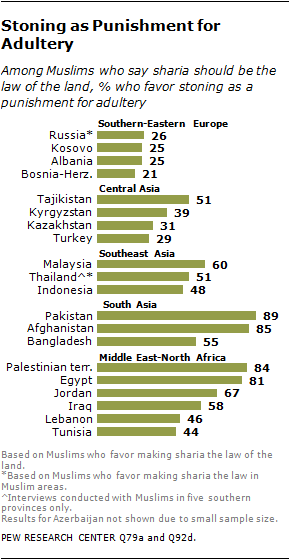
In 10 of 20 countries where there are adequate samples for analysis, at least half of Muslims who favor making sharia the law of the land also favor stoning unfaithful spouses.18
Some of the highest support for stoning is found in South Asia and the Middle East-North Africa region. In Pakistan (89%) and Afghanistan (85%), more than eight-in-ten Muslims who want Islamic law as their country’s official law say adulterers should be stoned, while nearly as many say the same in the Palestinian territories (84%) and Egypt (81%). A majority also support stoning as a penalty for the unfaithful in Jordan (67%), Iraq (58%). However, support is significantly lower in Lebanon (46%) and Tunisia (44%), where less than half of those who support sharia as the official law of the land believe that adulterers should be stoned.
In Southeast Asia, six-in-ten Muslims in Malaysia consider stoning an appropriate penalty for adultery. About half hold this view in Thailand (51%) and Indonesia (48%).
Muslims in Central Asia as well as Southern and Eastern Europe are generally less likely to support stoning adulterers. Among those who favor Islamic law as the official law of the land, only in Tajikistan do about half (51%) support this form of punishment. Elsewhere in the two regions, fewer than four-in-ten favor this type of punishment, including roughly a quarter or fewer across the countries surveyed in Southern and Eastern Europe.
Penalty for Converting to Another Faith
gsi2-chp1-9
Compared with attitudes toward applying sharia in the domestic or criminal spheres, Muslims in the countries surveyed are significantly less supportive of the death penalty for converts.19 Nevertheless, in six of the 20 countries where there are adequate samples for analysis, at least half of those who favor making Islamic law the official law also support executing apostates.
Taking the life of those who abandon Islam is most widely supported in Egypt (86%) and Jordan (82%). Roughly two-thirds who want sharia to be the law of the land also back this penalty in the Palestinian territories (66%). In the other countries surveyed in the Middle East-North Africa region, fewer than half take this view.
In the South Asian countries of Afghanistan and Pakistan, strong majorities of those who favor making Islamic law the official law of the land also approve of executing apostates (79% and 76%, respectively). However, in Bangladesh far fewer (44%) share this view.
A majority of Malaysian Muslims (62%) who want to see sharia as their country’s official law also support taking the lives of those who convert to other faiths. But fewer take this position in neighboring Thailand (27%) and Indonesia (18%).
In Central Asia as well as Southern and Eastern Europe, only in Tajikistan (22%) do more than a fifth of Muslims who want sharia as the official law of the land also condone the execution of apostates. Support for killing converts to other faiths falls below one-in-ten in Albania (8%) and Kazakhstan (4%).
Views on Current Laws and Their Relation to Sharia
gsi2-chp1-10
Many Muslims say their country’s laws do not follow sharia, or Islamic law. At least half take this view in 11 of the 20 countries where the question was asked. Meanwhile, in six countries, at least half of Muslims believe their national laws closely adhere to sharia.
Muslims in Southern and Eastern Europe and Central Asia are among the most likely to say their laws do not adhere closely to Islamic law. A majority of Muslims in Bosnia-Herzegovina (68%), Russia (61%) and Kosovo (59%) take this view. Roughly four-in-ten Muslims in Albania (43%) also say their country’s laws do not follow sharia closely, and about half (48%) are unsure.
In Central Asia, at least half of Muslims in Kazakhstan (72%), Azerbaijan (69%) and Kyrgyzstan (54%) say their laws do not follow sharia closely. In Tajikistan, by contrast, 51% say the laws of their country follow sharia.
In the Middle East-North Africa region, Muslims differ considerably in their assessments on this question. Lebanese Muslims (79%) are the most likely to say their country’s laws do not follow Islamic law closely. At least half of Muslims in the Palestinian territories (59%), Jordan (57%), Egypt (56%) and Tunisia (56%) say the same. Fewer Muslims agree in Iraq (37%) and Morocco (26%).
In the two countries in Southeast Asia where the question was asked, at least half of Muslims say their country’s laws adhere to sharia. By a 58%-to-29% margin, most Malaysian Muslims say their laws follow sharia; in Indonesia, the margin is 54% to 42%.
gsi2-chp1-11
Muslims in Afghanistan stand out for the high percentage (88%) that says their laws follow sharia closely. Fewer Muslims in the other countries surveyed in South Asia believe their laws closely follow sharia (48% in Bangladesh and 41% in Pakistan).
Across the countries surveyed, many Muslims who say their laws do not follow sharia believe this is a bad thing. Muslims in South Asia are especially likely to express this sentiment, including at least eight-in-ten Muslims in Pakistan (91%), Afghanistan (84%) and Bangladesh (83%). In Southeast Asia and the Middle East-North Africa region, too, Muslims who believe their country’s laws depart from sharia tend to say this is a bad thing. At least six-in-ten in the Palestinian territories (83%), Morocco (76%), Iraq (71%), Jordan (69%), Egypt (67%), Malaysia (65%) and Indonesia (65%) hold this view. Somewhat fewer Muslims in Tunisia (54%) say the same.
In the Middle East-North Africa region, Lebanon is the only country where opinion on the matter is closely divided. Among Lebanese Muslims who say their laws do not follow sharia closely, 41% say this is a good thing, while 38% say it is a bad thing, and 21% have no definite opinion.
Muslims in Southern and Eastern Europe and Central Asia are less likely to say it is a bad thing that their country’s laws do not follow sharia. Among Muslims who believe their country’s laws do not follow sharia, fewer than a third in most countries surveyed in these regions say this is a bad thing, while many say it is neither good nor bad, or express no opinion. The two exceptions are Russia and Kyrgyzstan, where almost half (47% each) say it is a bad thing that their country’s laws do not adhere closely to Islamic law.
Footnotes:
15 In Thailand, respondents were asked if sharia should be made the official law in the predominantly Muslim areas of the country. (return to text)
16 See Quran 4:22-4; 65:1-6; 4:11-2. See also Hourani, Albert. 1991. “A History of the Arab Peoples.” Harvard University Press, page 65. (return to text)
17 Certain hadith specify that some crimes, including theft, merit corporal punishments, such as whipping or the cutting off of hands. See Sahih al-Bukhari 81:771, 81:778, and 81:780. (return to text)
18 Certain hadith prescribe stoning as the appropriate penalty for adultery. See Sahih al-Muslim 17:4192 and 17:4198. (return to text)
19 Certain hadith either state or imply that the penalty for apostasy, or converting to another faith, is death. See Sahih al-Bukhari 52:260 and 83:37.(return to text)
Photo Credit: © Scott E Barbour